
Q&A with author David Solomons
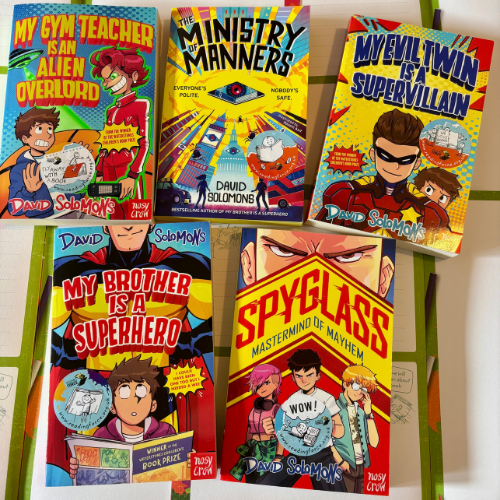
Award winning author David Solomons’ wonderfully hilarious books are familiar to many Reading Force families, as we’ve been posting them to you since he first published My Brother is a Superhero in 2016! He has won the Waterstone’s Children’s book Prize and the Laugh Out Loud Book Award for My Gym Teacher is an Alien Overlord. We are so excited to welcome David to our Q&A…

I describe myself as an accidental children’s author. For a long time, I had no ambition to write novels – mostly because I was convinced it’d be too difficult. Too many words! How does anyone sit still that long to write so much?
Which is why I began my writing career as an advertising copywriter (slogans being very short), and then as a screenwriter (film and TV scripts being shorter than novels). Eventually, I found a chair that was evidently comfortable enough for me to imagine sitting in it long enough to write a full-length novel.
After a few false starts, I found myself sitting there one day when a sentence popped into my head: ‘My brother is a superhero, and I could’ve been one too, except that I needed to go for a wee.’ From that line came My Brother is a Superhero, my first published children’s novel, which rather unexpectedly changed the direction of my career.
As for writing funny books, I think humour is just the way I naturally approach stories. A lot of writers will tell you that they use humour to write about difficult themes. They’re right, but I’ve realised that for me it’s a reflex. Even when something dramatic or frightening is happening, I tend to notice the ridiculous side of it first.
Sometimes, I reach for a gag when I shouldn’t. OK, I have a chicken problem. I’m admitting it here. Which is to say that I realised only after writing several novels that the first draft of each of them contained a ‘funny chicken’ moment or character. Thankfully, my editor noticed too and, where appropriate, the chicken was deleted from the next draft.
I’ve met a lot of children over the years who describe themselves as people who ‘don’t like reading’. And right now we’re going through a moral panic about children having shorter attention spans. I’m not entirely convinced by that. Perhaps it’s simply that they haven’t yet found the book that makes reading feel worthwhile.
I think that puts some responsibility back on the rest of us: writers, publishers, booksellers, teachers, parents. If a child isn’t interested, it’s very easy to decide that the problem is the child. Sometimes the problem is the book. Or the way we’ve presented books to them.
Humour can be enormously useful because it offers an immediate reward. If you can make somebody laugh on the first few pages, the book has already given them something. Reading stops feeling like homework or a test they’re going to fail.
I also think children sometimes encounter books surrounded by rather a lot of adult seriousness. We tell them how important reading is, how good it is for them, how they must do twenty minutes of it every night, and then wonder why some of them regard books with suspicion. Nobody has ever successfully sold me chocolate by explaining its educational benefits.
I tend to start with a situation that strikes me as funny or intriguing. With My Brother Is a Superhero, it was the basic injustice of Luke being the world’s biggest superhero fan and then missing his chance to acquire superpowers because he’d gone for a wee.
Once you have that situation, you start asking questions. What kind of person would find this especially unbearable? What sort of brother would be given the powers instead? How would they behave towards one another? That’s when the characters begin to take shape.
Sadly, none of them has ever simply appeared fully formed and dictated a book to me. It would save an enormous amount of time.
Lately, I’ve been writing something called Children of the Palace, which is certainly the darkest story I’ve yet told, although it still contains plenty of humour (mostly of the siblings being annoyed with each other variety). It’s told in the first person, from the point of view of Clara, the daughter of a dictator, and it’s set in the final days of the regime. Trying to bring down an entire dictatorship in a 40,000-word children’s book has been challenging.
Every book seems to find its own inventive way of becoming difficult at some point. They are very resourceful like that.
I knew remarkably little about Army life before I met Katie (Major King, sorry). Like most civilians, I think I understood the obvious things about deployment and separation, but I hadn’t really appreciated how deeply Army life can shape the lives of the whole family.
Katie has two children, and seeing Army life from the family’s point of view has certainly made me much more aware of organisations like Reading Force. Books are a particularly lovely way of keeping a connection going because they give families something shared. Even when people aren’t physically together, they can still inhabit the same story and talk about it.
I’m also currently developing a screenplay with some military characters, so Katie gets regular WhatsApps from me asking about details of terminology. Mostly the sort of thing I’d otherwise get wrong and be corrected on immediately by anyone who’d ever worn a uniform.
Radio communications are the big one. I’m forever asking her how people would actually talk to one another on the radio. When she watched Star Wars for the first time a few weeks ago (I know!), Han Solo swooped in during the Death Star attack, cleared Darth Vader out of Luke’s way and radioed, ‘You’re all clear.’ Katie’s immediate response was: ‘How does he know what frequency Luke’s on?’
I thought that was a rather perfect illustration of how an Army brain works. Faced with one of the most famous climaxes in cinema, she was worrying about the comms plan.
My next book is Spyglass: Coldfinger, the second book in the Spyglass series, which is published in October 2026. After that, Children of the Palace will be published in May 2027.
At the moment I’m reading A Fraction of the Whole by Steve Toltz. For some reason, I’m particularly drawn to books about middle-aged men having midlife crises, preferably in some flyover state of the US. This one is set in Australia, but I’m allowing it as an exception.